Forecasting urban growth with Machine Learning and Bayesian Networks
- Bradley Rasmussen
- Oct 10, 2025
- 2 min read
Updated: Feb 16
KEY TAKEAWAYS:
Urban development data is sparse and incomplete - traditional forecasting struggles with scenarios that haven't happened yet.
Forecaz combines Bayesian Networks with machine learning to encode planning expertise directly into forecasting algorithms.
This hybrid approach enables confident infrastructure decisions even when historical development patterns are inconsistent.
The methodology has been academically validated at the University of Melbourne's BNMA 2025 Conference.
By augmenting data with domain knowledge, planners can forecast growth scenarios before they occur.
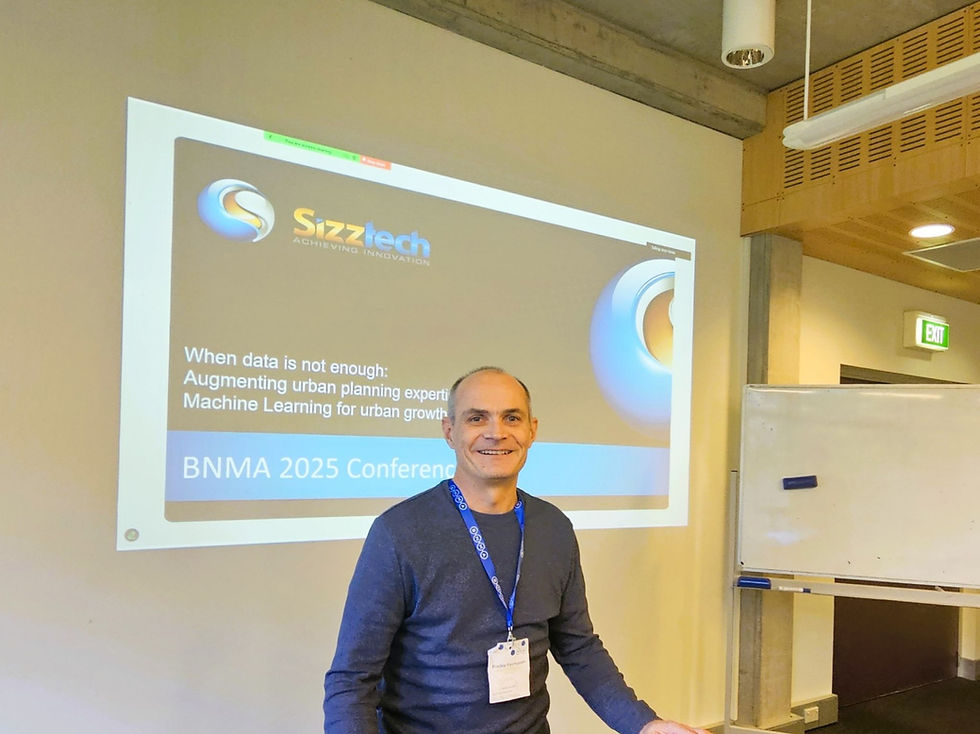
In October 2025, Forecaz had the privilege of participating in the Bayesian Network Modelling Association (BNMA) 2025 Conference hosted by the University of Melbourne - a gathering of researchers and practitioners focused on advancing applied probabilistic modelling.
Though an intimate event with fewer than 30 participants, the small setting created a rare opportunity for genuine collaboration, in-depth discussion, and one-on-one engagement.
Bridging expertise and data
Our presentation, When Data Is Not Enough: Augmenting Urban Planning Expertise with Machine Learning for Urban Growth Forecasting, explored how Bayesian Network models can be leveraged to tackle one of the toughest challenges in urban analytics: predicting city growth when historical data is imperfect or incomplete.
KEY POINTS INCLUDED:
The challenge:
Urban development data is often sparse, imbalanced, and fails to represent unfeasible development scenarios.
The approach:
Combining domain knowledge - encoded into Bayesian Network structures -with development data to train more resilient and accurate machine learning models.
The impact:
This hybrid method is at the core of how Forecaz scales urban growth forecasting, empowering planners, researchers, and policy teams to make data-backed decisions with greater confidence.
We’re grateful to the conference organisers, speakers, and attendees for fostering such a supportive and innovative space for sharing ideas. Events like BNMA 2025 remind us why this field continues to evolve rapidly and why collaboration between academia and applied platforms like Forecaz remains so vital.
At Forecaz, we’re redefining how cities anticipate and plan for growth through AI-driven forecasting.