AI and urban growth: presenting at the PIA QLD Conference
- Bradley Rasmussen
- Sep 1, 2025
- 2 min read
Updated: Feb 16
KEY TAKEAWAYS:
Forecaz together with Toowoomba Regional Council presented at the PIA QLD Conference 2025, demonstrating how AI-generated forecasts validate structure plans before adoption.
Traditional planning struggles to predict which growth areas will actually develop while Forecaz's AI model forecasts that only 43% of identified areas activate within 30 years.
Bayesian Networks translate planner intuition into development propensity scores for individual properties, creating sequenced forecasts that reflect policy intent and real-world constraints.
Evidence-based growth modelling provides the investment rationale councils need to secure grant funding like Queensland's Residential Activation Fund.
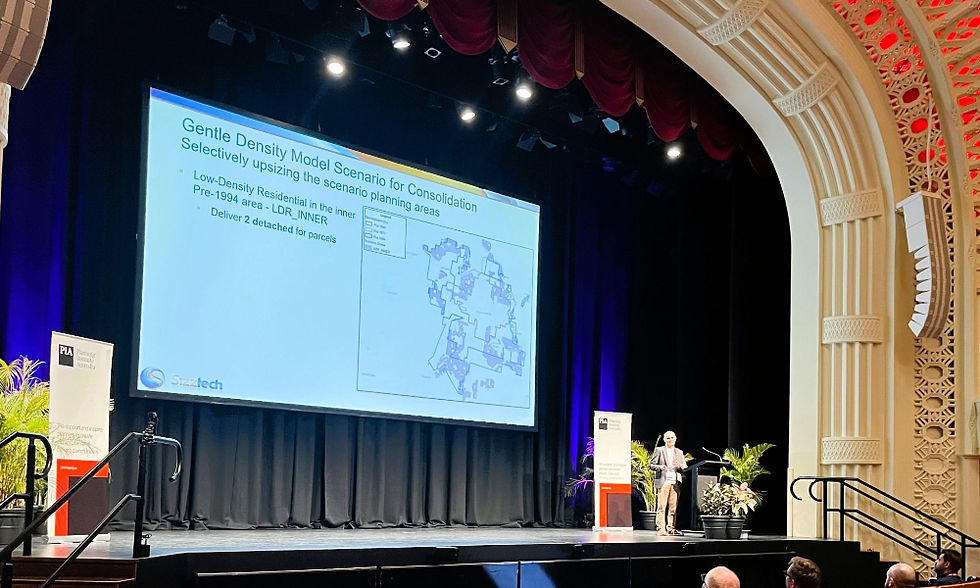
The Planning Institute of Australia’s Queensland Conference is an inspiring gathering of industry leaders exploring the evolving role of technology in shaping urban growth.
Forecaz was proud to present at the 2025 event, unpacking how artificial intelligence can bridge the gap between planning intent and real-world development outcomes.
AI‑Powered Urban Growth Model
Sharing the stage of the historic art-deco Empire Theatre, I joined Mahmudul Haque from Toowoomba Regional Council to present our collaborative work on the AI‑Powered Urban Growth Model - a system designed to merge expert planning knowledge with predictive analytics for smarter, more sustainable development forecasting.
Codifying Knowledge with AI
The model translates planner intuition into a Bayesian Network framework that determines development propensity for individual properties. This creates a sequenced forecast of growth that reflects both policy intent and real-world constraints.
Aligning Growth with Infrastructure
A critical feature of the model ensures that development aligns with the capacity of existing and planned infrastructure. By sequencing growth alongside water and sewer network capacity, the system helps avoid unserviceable expansion and improves network efficiency.
Evidence-Based Scenario Modelling
Through scenario testing, we demonstrated that only 43% of identified growth areas would likely be taken up within 30 years - a powerful insight for long-term land supply management. The model also supports testing “gentle density” policies, identifying suitable parcels for infill development by examining factors such as lot coverage and frontage.
Validating Plans and Supporting Investment
The tool enables councils to test structure plans before adoption, identifying where proposed zonings may fall short of intended density outcomes by 2051. Importantly, these outputs form the foundation for infrastructure investment rationale - helping councils like Toowoomba secure Residential Activation Fund (RAF) support for targeted urban development.
Performance and Collaboration
Real-world validation has shown strong alignment between model predictions and actual dwelling delivery through Development Applications, confirming its effectiveness in forecasting land supply.
We were joined in the same session by industry peers including Geoff Anstey, Andrew Saad, and Matt Abbasi from the City of Gold Coast, who showcased the advanced dashboards and 3D/Digital Twin frameworks built on the Forecaz‑powered PUG model, as well as innovative AI applications using spatial imagery.
Our thanks go to Nicholas Kamols for hosting and bringing energy to what could otherwise have been a “dry,” data‑heavy topic - his facilitation set a dynamic tone for a forward‑looking session.
This conference session reinforced that the intersection of AI, planning, and infrastructure is not a futuristic concept - it’s already here, driving measurable value for local governments and communities today.
At Forecaz, we’re redefining how cities anticipate and plan for growth through AI-driven forecasting.